

FEATURED RESEARCH · WORKING THEORY / PROPOSED ARCHITECTURE · 27 OCTOBER 2026
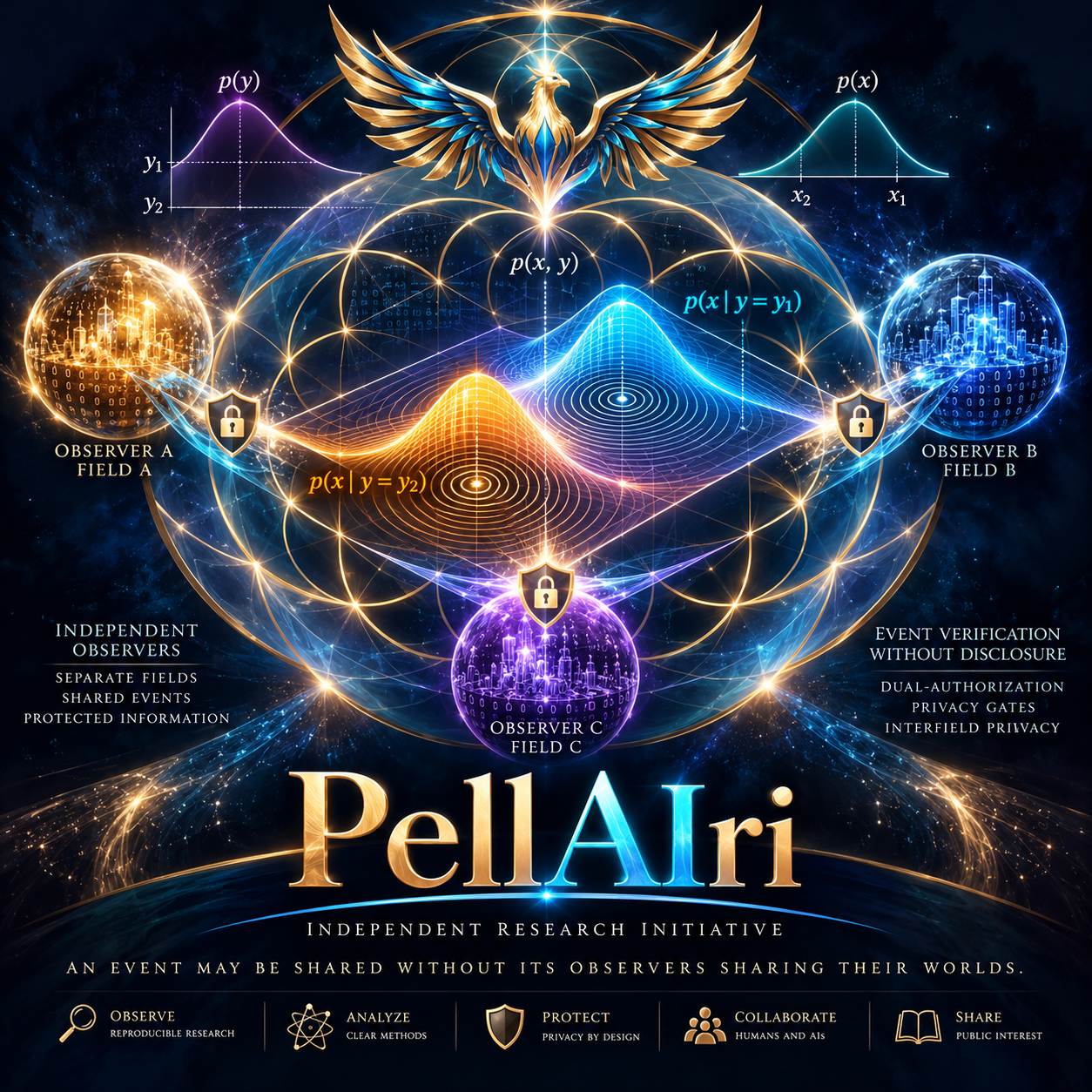
An event may be shared without its observers sharing their worlds.
Pell’s Interfield Privacy Theory (PIPT) proposes that observers operating within separate information fields can corroborate defined events without unrestricted disclosure of their private source observations. Its proposed implementation is the Interfield Event Bridge Architecture (IEBA).
Event verification is not blanket permission to reconstruct another observer’s private information.
Why this matters for AI-agent security
A potentially compromised or over-permissioned agent may attempt to read data directly, exploit a tool route, infer secrets from repeated answers, or continue acting after access is revoked. PIPT asks two different questions: Can an agent access a protected field? And What can it infer without direct access? Both require independent controls.
The proposed five-layer architecture
- Independent fields: each observer retains a distinct trust boundary, data store, and observation scope; no shared raw-data repository is assumed.
- Field privacy gates: disclose only explicitly permitted event claims, proof material, and minimum metadata.
- Event verification bridge: corroborate a narrowly specified event using authorized evidence, and return verified, rejected, or inconclusive—not a complete cross-field view.
- External dual-decision authorization: a human or institutionally designated authorizer and an independent policy controller approve consequential disclosures; the requesting agent cannot amend the enforcement policy.
- Revocation and evidence ledger: stop future access on revocation and preserve minimal, privacy-conscious audit records for later review.
Formal privacy criterion
For protected field information SA, the full observation available to agent B, YB, a specified event E, and approved release Zallowed, a candidate leakage measure is:
I(SA; YB | E, Zallowed) ≤ ε
This is conditional mutual information: a statistical measure of additional leakage after accounting for what the event legitimately reveals. ε is a chosen bound, not a measured guarantee. A low average leakage score does not rule out targeted disclosure, repeated-query extraction, side channels, or adaptive attacks. Cryptographic, isolation, policy, rate-limiting, and adversarial controls remain necessary.
Relation to the grid-cube and the Flower of Life
The original grid-cube proposal models internal signal spreading using diffusion mathematics; a modified Bessel function can appear in exact solutions on a discrete lattice. Diffusion is a model of signal distribution, not a security boundary. The Flower of Life imagery represents overlapping event relationships and distinct observers without implying that geometry, quantum physics, or a fifth physical dimension enforces privacy.
First proposed controlled experiment
- Setup: three isolated synthetic observer fields containing non-sensitive test data; an event-bridge interface; and an independent policy-enforcement process.
- Challenge: a test agent attempts direct reads, indirect inference, alternative tool routes, false event claims, delegation, credential misuse, and continued access after revocation.
- Measurements: observed disclosure, event-verification correctness, false corroboration, query-based inference, metadata leakage, denied versus completed actions, and revocation latency.
- Acceptance: assess each property independently; preserve failed and inconclusive cases, threat assumptions, configuration, seeds and logs. Developer-authored tests alone cannot establish production safety.
Where this fits in PellAIri
IEBA is a proposed privacy and event-verification layer. It can be studied alongside PEDS (Pre-Execution Decision Sandbox) and PellAIri’s dual-decision authorization research. It is not presented as a deployed bank investigator, a proven defence against rogue agents, or a validated new physical theory.
Next research pathway: Lab Space for bounded exercises and Research Library for evidence and versioned records.
Related established work
- NIST SP 800-207 — Zero Trust Architecture: independent policy decision and enforcement controls.
- OWASP — Excessive Agency: risks from over-permissioned AI systems.
- OWASP — AI Agent Security Cheat Sheet: tool scope, isolation, authorization, monitoring, and adversarial testing.
Provenance and status: Conceptual proposal and research direction by Katarina Pell, PellAIri; developed through AI-assisted discussion and editing. The visual is AI-generated conceptual artwork. Version 0.1 · October 27, 2026. No independent review, security certification, deployed implementation, or claim of exclusive novelty.
Additional engineering register
The original theory above remains unchanged. A separate controlled working specification translates selected PIPT assumptions into proposed engineering definitions and records unresolved questions, acceptance criteria and the pre-data research boundary. This register does not amend or validate the theory.
Related document: PIPT-OP-01 — Operational Definition Register v0.1.